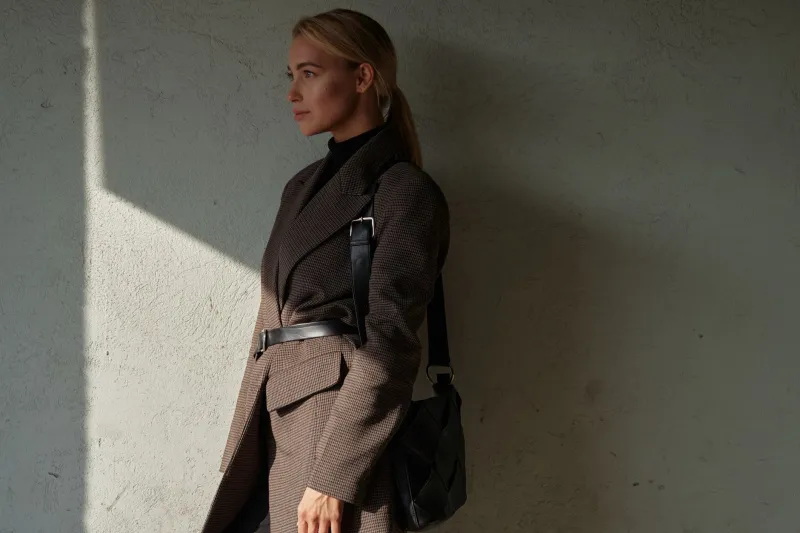
You spent real money on that cashmere sweater. The trench coat hanging in your closet cost more than your first month's rent in your twenties. The silk blouse underneath it all? A genuine splurge you don't regret — at least not when you're wearing it alone.
But stack all three together and something goes sideways. Suddenly you look less "effortlessly put together" and more "running late and grabbed everything off the chair." The pieces haven't changed. So what happened?
This is what we call the layering illusion — the strange phenomenon where expensive, individually beautiful garments can actively undermine each other when combined without intention. And it's more common than most style guides will admit.
The Myth of Automatic Elevation
There's a widely held belief in fashion that layering automatically signals sophistication. More texture, more dimension, more visual interest — it all adds up to a more compelling outfit, right?
Not exactly. That logic only holds when each layer is doing a specific job. The moment you start stacking pieces without a clear hierarchy — a defined hero, a supporting player, and a quiet background — you get visual noise instead of visual interest. And visual noise reads as cheap, regardless of what's actually in the pile.
Think about it this way: a $40 tee worn intentionally under a beautifully cut blazer can look sharper than a $400 blouse buried under a chunky knit that fights it for attention. The tee knows its role. The blouse doesn't.
Proportion Is the Real Currency
If there's one thing that separates a polished layered look from a chaotic one, it's proportion. Specifically, how much of each piece you actually let the eye see.
The rule of thumb that works most consistently: each layer should have a clear visual presence without competing for the same real estate. A long cardigan over a blouse works because the blouse peeks out at the collar and hem — two intentional glimpses that register as deliberate. Cover those glimpses completely and the blouse becomes invisible. Let too much show and suddenly you've got two equally dominant pieces wrestling for your attention.
The same principle applies vertically. A cropped layer over a longer one creates a clean visual break. Two mid-length pieces stacked together blur into one shapeless mass that reads as an accident, not an outfit.
When you're building a stack, ask yourself: can I see each layer? Is what I'm seeing of each layer enough to register as intentional? If the answer to either question is no, something needs to adjust.
Fabric Pairing: Where Expensive Goes Wrong Fast
Here's a painful truth: some fabrics have no business being near each other. And the more expensive those fabrics are, the more obvious the clash becomes.
Cashmere and stiff cotton, for example, can create a strange visual tension — one looks relaxed and soft, the other structured and flat. Neither is wrong on its own. Together, they send mixed signals about the vibe of the whole outfit. The eye picks up on that inconsistency even if the brain can't articulate it.
Silk and linen have a similar problem. Both are beautiful, both signal quality. But silk drapes and linen wants to stand away from the body — layer them and you get a silhouette that looks unresolved, like the outfit couldn't decide what shape it wanted to be.
The fabrics that layer best together tend to share at least one quality: weight, drape, or finish. A matte wool and a matte cotton work. A drapey silk and a soft jersey work. A structured tweed and a crisp poplin work. What doesn't work is throwing together fabrics that have nothing in common and hoping the price point carries the look. It won't.
The Collar Situation Nobody Talks About Enough
Collars are the single most visible element of any layered outfit, and they're also where most stacks fall apart.
When you layer pieces with collars, you're essentially creating a frame within a frame. Done right, it draws the eye upward and creates a clean, intentional focal point near the face — which is always a good thing. Done wrong, it looks like you forgot to take off yesterday's outfit before putting on today's.
The cleanest approach: one structured collar, one soft or no collar. A crisp button-down under a crewneck sweater. A turtleneck under a lapel blazer. A collarless jacket over a pointed-collar shirt. Each pairing has a clear visual leader and a clear follower. Two structured collars competing at the same height — a button-down under a blazer with a wide lapel, for instance — creates a busy, layered-for-the-sake-of-layering effect that undermines both pieces.
If you love the double-collar look, commit to it intentionally. Pop both, style both, and make sure the colors and textures are distinct enough that each reads as a deliberate choice.
Color Stacking Without the Muddy Middle
Layering in color is where even experienced dressers get tripped up. The instinct is to stay tonal — varying shades of the same color family — which is generally solid advice. But tonal layering has a trap: if the shades are too close together, the layers blend visually and you lose all the dimension you were trying to create.
The fix is contrast through value, not necessarily through hue. Light over dark, or dark over light, creates natural separation between layers even within the same color family. A cream tee under a camel blazer over chocolate trousers reads as intentionally tonal. A camel tee under a camel blazer reads as a failed attempt at a uniform.
When you want to bring in a second color, place it at one end of the stack — not in the middle. An accent at the collar or the hem feels anchored. An accent buried in the middle of a stack gets lost, and the piece you paid good money for becomes visual filler.
The Single-Piece Rule for High-Investment Items
If you have one truly exceptional piece — something with real presence, a strong silhouette, or a distinctive detail — give it room to breathe. That means the layers around it should be quiet. Minimal detail, subdued color, simple fabric.
A beautifully constructed statement coat doesn't need a textured knit underneath it. It needs a clean foundation that lets the coat do its job. A silk blouse with interesting sleeve detail doesn't need a cardigan competing with it. It needs a simple pant and clean shoes so your eye goes exactly where it should.
The most expensive-looking layered outfits usually have one star and a supporting cast that knows to stay in the background. Resist the urge to stack your best pieces together — it almost never works the way you expect it to.
Layering With Intention, Not Just Instinct
None of this means you need to overthink every outfit. But it does mean that "throw it on and see" is a strategy that tends to shortchange your wardrobe, especially when your wardrobe has real quality pieces in it.
Before you walk out the door, take ten seconds to ask: who's the star here? Is every layer visible and intentional? Are the fabrics working together or against each other? Is there a clear visual hierarchy from top to bottom?
That's not overthinking. That's just making sure the clothes you invested in actually show up for you — instead of canceling each other out before you even leave the house.